
Dearborn County Civil Docket Searches
Indiana MyCase is the main public search. It covers Dearborn County civil cases that are not confidential. A full case number works best. With a name search, add the Dearborn County court filter, a filing-date range, or a civil case type. Business names may need exact wording or a wildcard. MyCase can return a CCS and selected public documents. It is not the filing system, though. Not every public pleading has an online image. When a civil event lacks an image, a historic file is not online, a balance needs confirming, or you need a certified judgment, turn to the Dearborn County Clerk of Courts. The clerk offers public terminal and counter access and maintains the official record.
- Choose a Case, Name, or Attorney search in MyCase.
- Limit results to Dearborn County and the likely civil case type.
- Match the parties, filing date, court identifier, and case number.
- Read the newest CCS event, hearing, and case status.
- Give the clerk the exact case number and document title for a copy request.
Dearborn Civil Search Codes
Civil is a broad label. Three useful starting points in Dearborn County are CT for civil tort, PL for civil plenary, and SC for small claims. Other codes include CC for civil collection, EV for eviction, and MF for mortgage foreclosure, plus estate codes such as EM, ES, or EU, guardianship codes GM or GU, TR for trusts, and PO for protection orders. The live case type controls what you see. Never assume every civil file carries the same remote document access.
| Code | Typical matter | Search approach |
|---|---|---|
| CT | Civil tort | Filter the court and compare all party names. |
| PL | Civil plenary | Use the complete caption or case number. |
| SC | Small claim | Check Superior Court and the newest judgment event. |
| EM/ES/EU | Estate | Search Circuit Court and expect access limits. |
| GM/GU/TR | Guardianship or trust | Confirm public availability with the clerk. |
A protection or domestic matter can stay restricted even when a general civil name search runs broad. Treat the case-type filter as a routing tool, not a promise of access.
Civil Dockets: What They Show
The CCS, short for Chronological Case Summary, is the event-by-event civil docket in Indiana. It lists the case number, court, type, filing date, caption, party roles, attorneys, and status. Later lines may cover the complaint or petition, the answer, service, appearances, motions, responses, notices, mediation, trial settings, orders, judgment, dismissal, fees, and post-judgment proceedings. Some entries link to public documents. Others are text lines only.
| Case number | 15D01-2608-CT-000123 is a neutral Superior I tort example. |
|---|---|
| Parties | Plaintiff, defendant, petitioner, respondent, estate, and counsel roles appear when public. |
| Service | Issuance, return, appearance, or failed-service events may affect the next step. |
| Hearings | Dates and types can include motion, status, mediation, bench trial, or jury trial settings. |
| Judgment | Default, final judgment, dismissal, monetary award, and enforcement events may follow. |
A public event does not prove its exhibit or financial detail is public. Read the event label, order date, and current status together.
Dearborn Civil Number Patterns
Indiana Administrative Rule 8 gives every case number four groups. Dearborn County uses county code 15, with the first group naming the court, the second carrying year and month, the third the case type, and the last the sequence. So 15C01-2608-ES-000123 is a neutral Circuit estate example, and 15D02-2608-SC-000123 is a neutral Superior II small-claim example.
- 15C01
- Dearborn Circuit Court, which handles probate and other assigned civil work.
- 15D01
- Dearborn Superior Court I, expressly identified with tort, plenary, small-claims, and other civil work.
- 15D02
- Dearborn Superior Court II, a general court of record.
- Judgment
- The court’s entered decision, which may still be followed by enforcement or appeal events.
No active 15E01 county court exists in Dearborn under the current numbering rule. A search tied to that abolished code likely involves older records, so check with the clerk.
What Cases Fill the Civil Docket
Dearborn Circuit Court handles probate, estates, guardianships, adoptions, trusts, and major civil matters. Superior Court I expressly lists civil tort. It also lists civil plenary, small claims, protective orders, and other proceedings. Superior Court II also holds general civil work. Subject alone may not identify the court. The case number and the current MyCase court field will.
- Tort, contract, collection, and other plenary claims
- Small claims and eviction matters
- Mortgage foreclosure and property disputes
- Estate, guardianship, probate, and trust proceedings
- Protection-order and other restricted civil matters
Circuit probate does not sit in a separate "county court" database. Search the Circuit identifier in MyCase, then use the clerk for public records not offered remotely.
Dearborn Superior Civil Work
The official Dearborn Superior Court I page lists its local mix of civil tort, plenary, traffic, small-claims, protection, and criminal work.
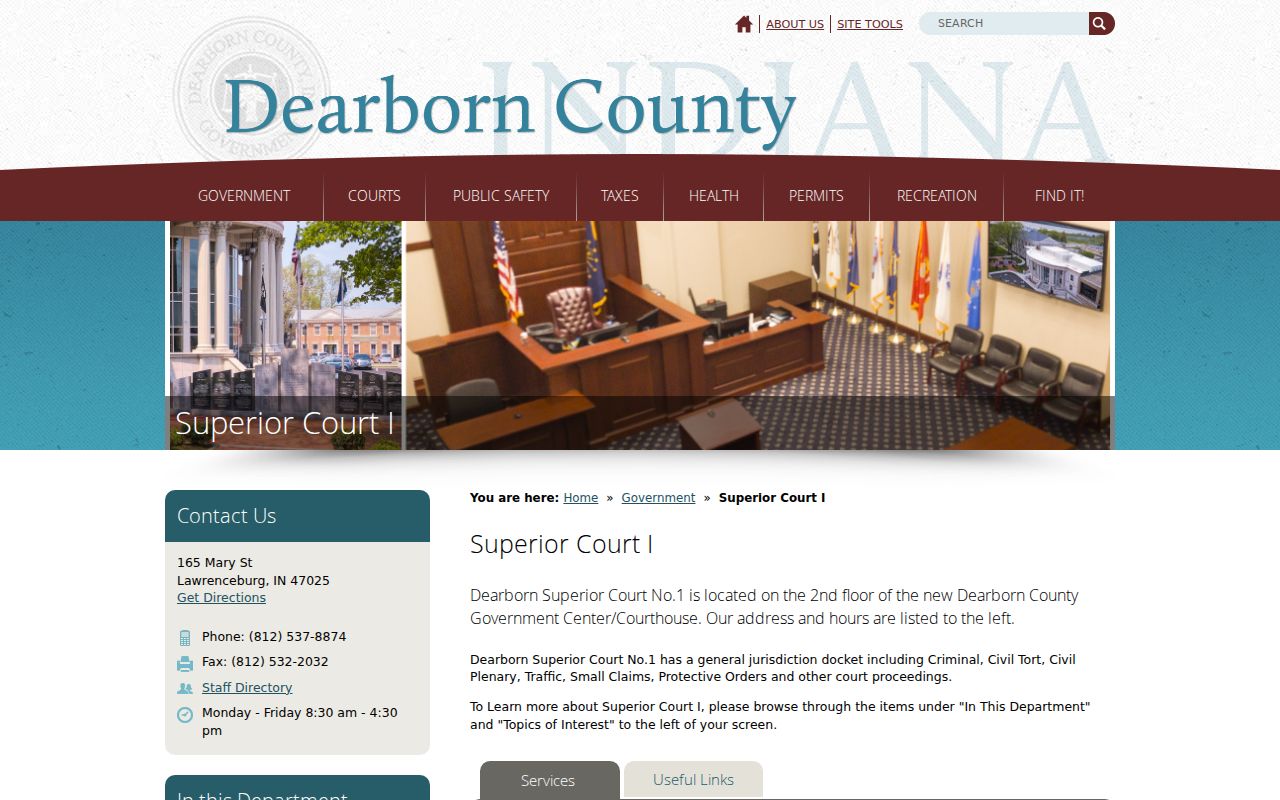
That mix shows why a civil search needs both court and case type. Superior Court I is not a civil-only division. A broad name result can blend civil, criminal, traffic, and other cases, while a case number such as a 15D01 CT or PL record points straight to the intended civil docket.
Myth: every Dearborn County civil matter is in Circuit Court. Fact: Superior Courts I and II also carry civil cases, and the live case number identifies the correct court.
Hearings on the Civil Docket
A civil setting can take many forms: a status conference, motion hearing, mediation event, bench trial, jury trial, damages hearing, or post-judgment proceeding. When details are public, the CCS shows a date, time, court, hearing type, and status. Be careful what you read into it. A filed motion has not been granted. A proposed order has not been entered until the court says so. Look for the later order or hearing result before drawing conclusions.
Continuances and resets create new events. When an older date was vacated, the later setting controls. Civil scheduling can also follow an entered case-management order. The next hearing may not be the final trial. Confirm any near-term or unclear setting through the court or clerk. The docket is authoritative case history. Staff can resolve a last-minute change that a cached view has not caught yet.
Note: Read the newest Dearborn County civil docket entry before relying on any earlier setting.
Why Dearborn Judgments Stay Open
A Dearborn County civil docket does not always close with the judgment. Money still has to move. Enforcement, supplemental proceedings, payment activity, attorney-fee fights, or an appeal can each add new CCS entries long after the ruling. A default judgment, for instance, may follow nothing more than service and a missed response, so read the full sequence of events before deciding what any line means. Service attempts, appearances, motions to set aside, and later orders can all shift where the case truly stands.
Civil event flow: Filing › Service › Answer or Default › Motions and Settings › Judgment or Dismissal › Enforcement or Appeal
Trust MyCase money figures only as a first look. Amounts on the screen can lag behind reality. A clerk-confirmed payoff or a certified judgment is the real number, not the display. State fee examples are filing costs, too. They are not copy prices. The Fee Manual lists separate examples for civil and small-claims filings, and the figure changes again when a small claim goes through IEFS. The clerk sets Dearborn County's own certified-copy charge, so ask for the current price directly.
Who Can See Civil Dockets
Indiana starts from a presumption that court records are open, with specific exclusions carved out. The official MyCase public-document access table shows that what you can pull remotely varies by civil case type.
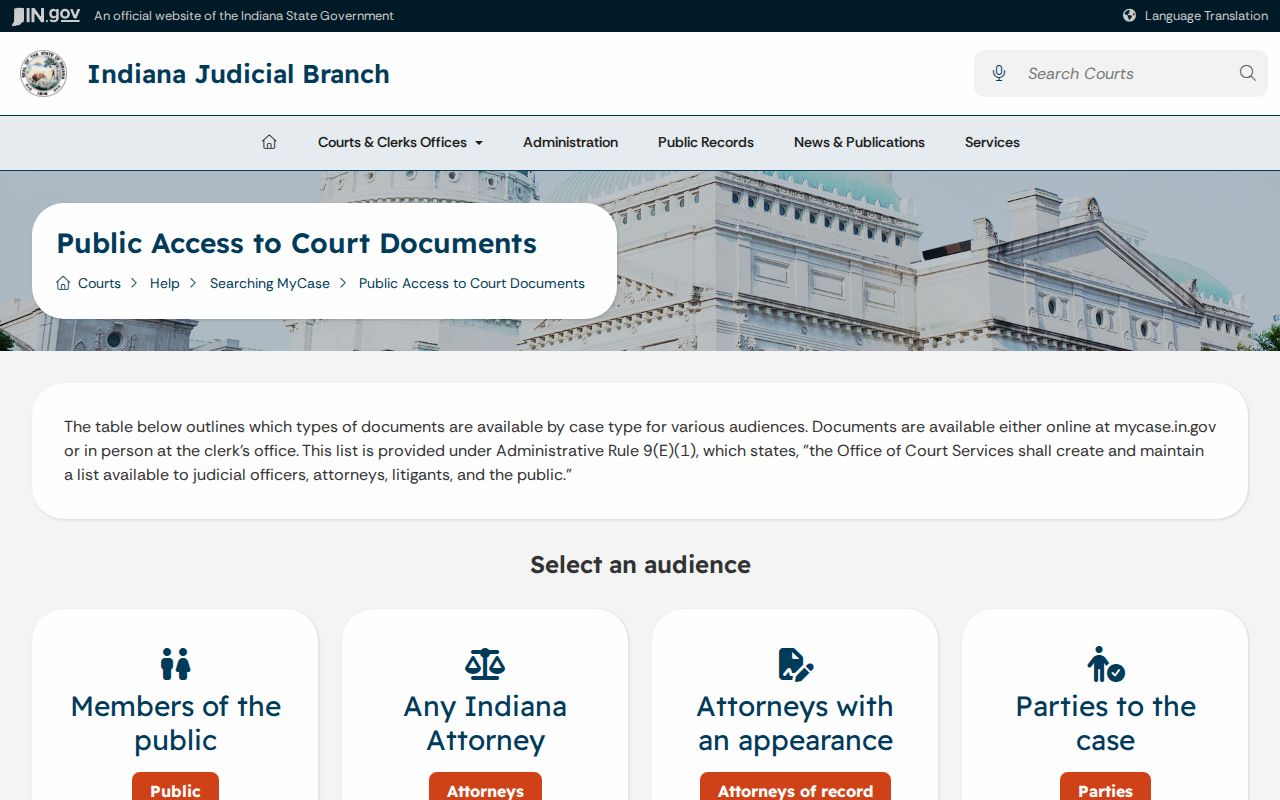
That table matters for docket readers at home. Tort, plenary, and foreclosure files tend to offer broader online documents. Small claims, evictions, estates, guardianships, trusts, domestic matters, and protection proceedings can be mixed or restricted instead. A public CCS line may still show up on a Dearborn County case lookup. The document image behind it may not.
Key rules:
Access Rule 4 provides public access unless an exclusion applies.
Access Rule 5 protects confidential cases, documents, and data.
Administrative Rule 9 governs remote and courthouse access.
Dearborn Civil Copy Requests
A judgment or pleading may not download. In that case, write down the exact case number, court, document title, and CCS event date. Take those details to the Dearborn County Clerk of Courts. Say whether you want a plain copy or a certified one. Certification is an authenticated clerk service. It is not the same as printing a free MyCase screen. The clerk can also explain inspection options for older public files.
Estate, guardianship, trust, domestic, protection, and similar matters call for extra care. A missing image does not mean a filing never happened. Ask about the record's status. It may be public, courthouse-only, limited to an authorized party, or excluded under Access Rule 5. Seeking an excluded record is an extraordinary request. It follows the verified procedure in Access Rule 9 and needs a court decision. That path is nothing like a routine copy request.
Note: Need an official record? Verify a Dearborn County civil judgment directly with the clerk.