
Name-Based Case Searches
For a name search in Dearborn County, Indiana MyCase is the main public tool. Open the Name tab and enter a business name. Or enter a person's last name paired with at least a first name, middle name, or date of birth. Broad spellings can drag in unrelated Indiana cases. So begin with the most accurate version you have. Then narrow by court, status, or filing date. Keep in mind that MyCase caps a broad result at 1,000 matches. Good filters matter.
- Open official Indiana MyCase and choose the Name tab.
- Enter the last and first name, or the business name, in the most exact known form.
- Limit results to a Dearborn court, then add status or filing dates if needed.
- Compare the caption, court, filed date, and case number before opening the CCS.
| Field Label | Type | Required | Notes |
|---|---|---|---|
| Last or Business Name | Text | Yes | Wildcards or sounds-like can broaden spelling matches. |
| First or Middle Name | Text | One added field | Try exact spelling before broadening. |
| Court | Selector | No | Choose a Dearborn court only after confirming likely venue. |
| File Date From/To | Date | No | Limits filing dates, not every event date. |
Choose the Right Dearborn MyCase Tab
MyCase splits its searches into three tabs: Case, Name, and Attorney. The Case tab takes a case number, citation number, or cross-reference number. One key is enough. Name suits a party or business. Attorney works with a bar number or lawyer name. Picking the wrong tab can hide a record that is really there. The official MyCase application is the direct starting point for any Dearborn County court docket lookup. Repeated requests can be interrupted by CAPTCHA and browser conditions. The service is not a bulk-data tool. When an ordinary public search fails, ask the Dearborn County Clerk of Courts for help rather than widening the query without limit.
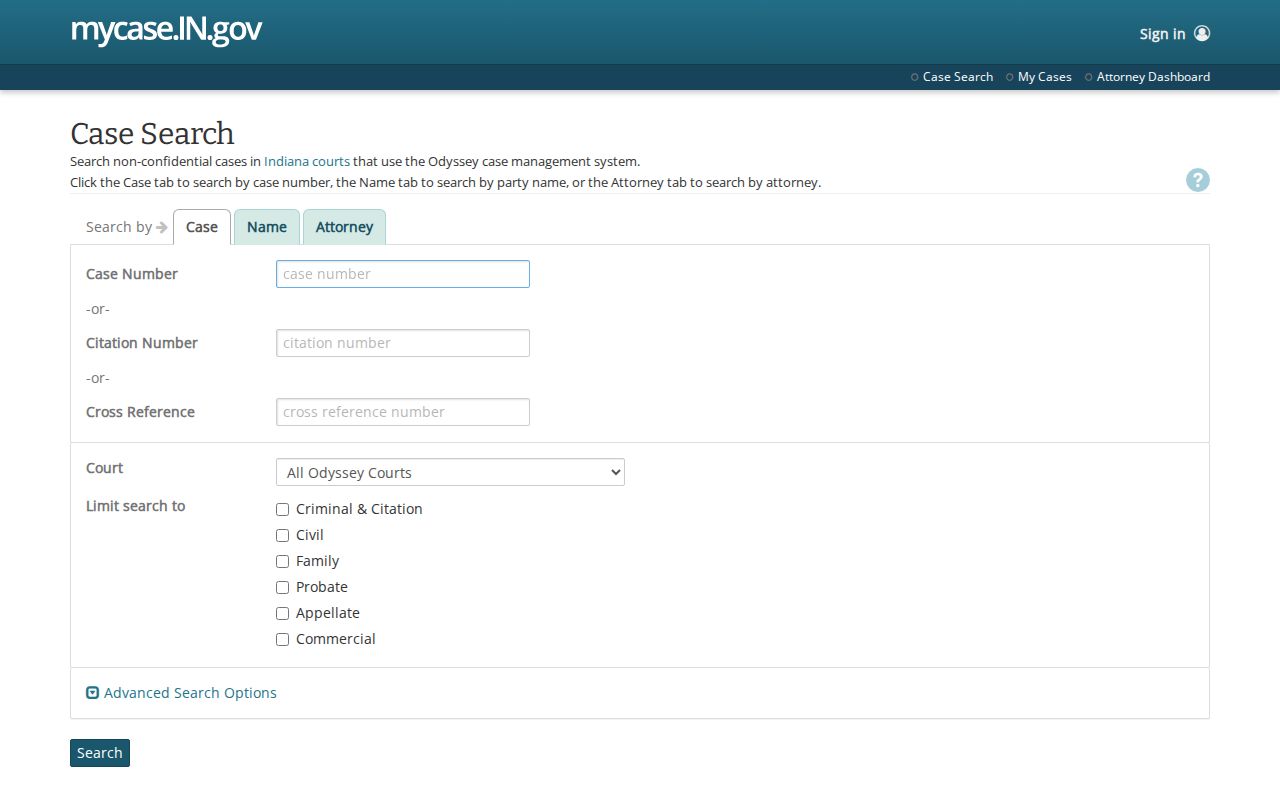
The interface image shows why selecting the proper tab is the first practical choice.
Case Number Searches
A Dearborn County case number tells a story in four parts. Take 15D01-2026-CF-000123. The 15 points to Dearborn County. D01 points to Superior Court I, 2026 to the filing year, and CF to the case type, while the trailing digits give the sequence. When a docket search asks for the case number, type the whole string. Include its separators if the form accepts them. Other Dearborn courts follow the same pattern: Circuit Court numbers start with 15C01, Superior Court II uses 15D02, and Lawrenceburg City Court uses 15H02.
Dearborn County Numbers Start with 15
That first group of digits doubles as a quick error check. Under Administrative Rule 8, a number that does not begin with 15 is not a Dearborn trial-court number. Old files may carry the abolished 15E01 County Court or 15H01 Aurora City Court codes. Do not rewrite those as a current division.
- 15C01
- Dearborn Circuit Court.
- 15D01
- Dearborn Superior Court I.
- 15D02
- Dearborn Superior Court II.
- 15H02
- Lawrenceburg City Court.
Codes like CF, F6, CT, PL, SC, IF, and OV classify the case. They say nothing about the outcome. For that, read the newest CCS entries.
Case Search Results Explained
A matching row just identifies a case. Click through, and the detail view supplies the Chronological Case Summary. Public results can show the caption, parties, attorneys, filing date, case type, status, financial indicators, future settings, and dated events. Document images vary by case type and access level. A visible CCS event does not guarantee that its filed document can be downloaded.
| Case Number | The court, year, case-type, and sequence identifier. |
|---|---|
| Style / Parties | The public caption and party roles, subject to redaction. |
| Case Type | The coded category, such as criminal, civil, small claims, infraction, or ordinance. |
| Filed Date | The date the clerk accepted the initiating case filing. |
| Status | An open, closed, or disposed indicator read with the latest CCS events. |
Dearborn CCS Events Are Not Always Documents
The CCS is an event history and index. It is not a promise that every paper is online. Indiana's public-document access table varies by case type. Civil tort and plenary matters may offer broader online documents, while domestic relations, juvenile, mental-health, protection-order, and other protected areas stay tighter. Even in a public case, some documents require courthouse inspection or a clerk request. The MyCase help page explains public, party, and attorney access. An authorized signed-in party may see material a general visitor cannot. Remember that free public case information is not a certified record. Displayed financial balances may not be current. Ask the clerk for certification or a current balance.
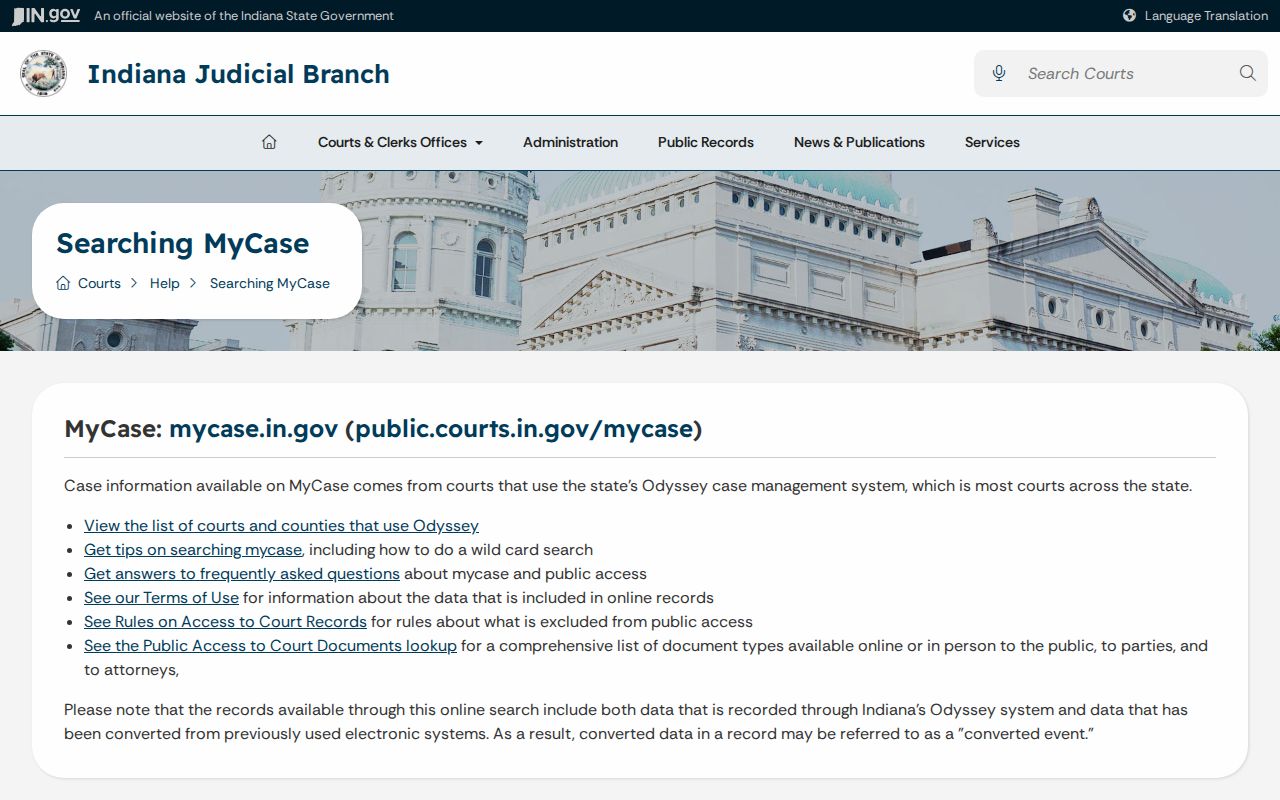
That is why a CCS event and a downloadable document image are separate questions.
Two Ways to Search: County and State
MyCase is the statewide public case-search layer. It is also the main online route promoted for Dearborn County. The county runs no second full party-name docket database of its own. Its clerk page supplies public-access assistance, courthouse terminals, payments, and record help. The county document center holds forms and other clerk materials. It is not the CCS index.
| Indiana MyCase | Dearborn County Channels |
|---|---|
| Nonconfidential Odyssey cases across participating Indiana courts. | Clerk help, courthouse terminals, local copies, and official records. |
| Public CCS detail and selected documents. | Inspection or copies when remote access is incomplete. |
| Best first step for a case number or party search. | Best fallback for certification and access questions. |
The Dearborn Clerk Terminal Fallback
When MyCase returns nothing useful, contact the Dearborn County Clerk of Courts. You can also use a courthouse public-access terminal. Bring the case number if you have it. Add a party name, an approximate filing period, and the likely court. The clerk can explain which public layer is available. The clerk can also tell you whether inspection, a copy request, or another court contact is needed. The Indiana courts' Odyssey court list documents participating courts.
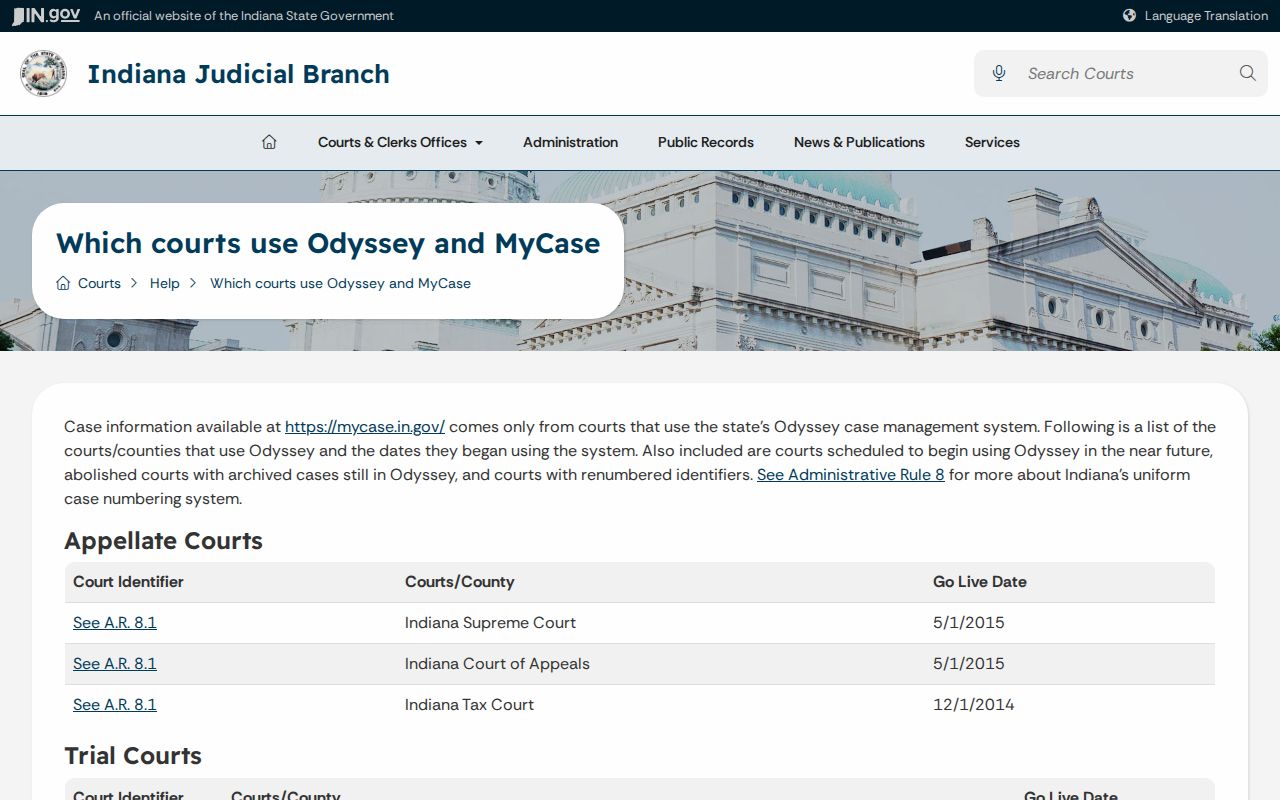
That court list shows why MyCase reaches statewide while clerk help stays local. The county document center can supply clerk forms and public county documents, but it cannot replace a MyCase party search. It organizes documents, not the CCS for every lawsuit or prosecution.
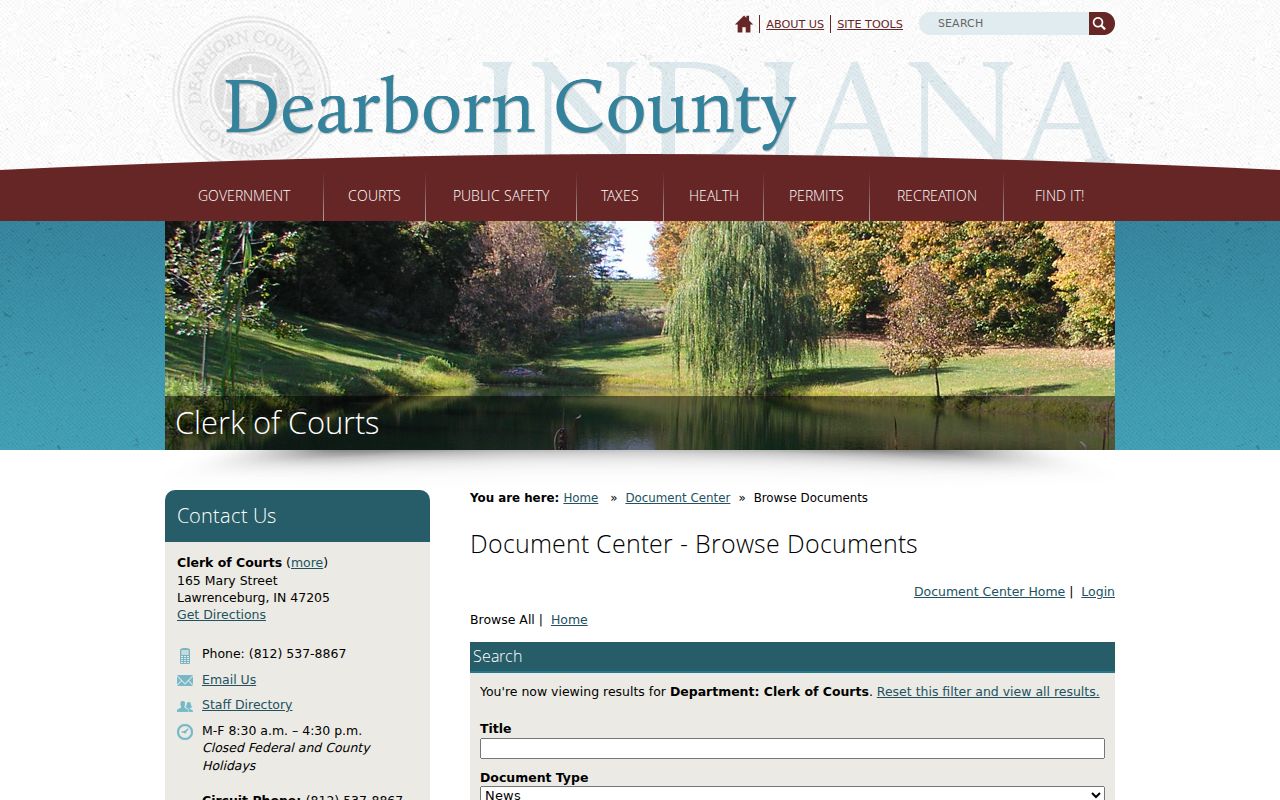
That local view drives home the gap between finding a case and finding a posted county document.
Which Cases Stay Restricted
Indiana starts from openness. The Access Rules treat court records as public unless a listed exclusion applies. Sealed, expunged, juvenile, CHINS, mental-health, adoption, and protection-order files may be hidden or trimmed, and some family and problem-solving cases too. Even a visible case can have names or details redacted. Keep this in mind: a docket search that returns nothing does not mean no case exists.
Ask the Dearborn County clerk which rule covers the record you want. For excluded records, Access Rule 9 offers a formal written route with verification, notice to the other side, a hearing, and a judge's decision. It grants nothing by itself. Attorneys and case parties may reach more through authorized accounts, but walking into the courthouse changes nothing, since the same exclusions and court controls apply there.
Dearborn Search Limits and Official Records
MyCase is convenient, and it says so itself. The site warns that public information can be incomplete or wrong, and it is not the certified original that the Dearborn County court holds. If a case was transferred, you may have to read the whole case chronology and trace the old court's identifier. Common names are their own trap. Spelling tools, court filters, and a filing range can narrow things down, yet each filter you add can also bury the one result you need.
Use "sounds like" when the spelling is only a guess. Use wildcards when you know part of a name, and don't stack both into one endless sweep. If nothing comes back, drop filters one at a time. Once you spot the right case, write down the full case number and the court. That single habit sharpens every later docket search and lets the clerk pull the official file fast.