
How the Dearborn County Court Calendar Works
Dearborn County posts no single page listing every hearing in every courtroom. Indiana Administrative Rule 9 governs calendars and dockets. But the practical route runs case by case. Pull up a nonconfidential case in Indiana MyCase and scroll to the newest entries in the Chronological Case Summary. That register, called the CCS, orders every filing, order, and hearing in the file. A later line may replace an older date that has already changed.
Division matters too. Circuit Court, Superior Court I, Superior Court II, and Lawrenceburg City Court each carry separate identifiers. A setting in one division cannot be assumed to happen in another courtroom. Court staff and Dearborn County Clerk of Courts Wendy Beatty keep the official record layers. Attorneys get added case notices through Indiana filing procedures. A web display helps. Still, the originating court confirms an appearance.
Dearborn County Has No Daily Calendar Portal
Many people hunt for one countywide grid of today's hearings. Dearborn County has none online. Settings are not private, though. The search just starts with the individual case. MyCase displays nonconfidential Odyssey cases, and the clerk offers public-access help plus a courthouse terminal.
Calendar versus CCS. A daily calendar groups matters by date or room. A CCS follows one case over time, including settings later reset or vacated.
When MyCase leaves a date unclear, open the county court directory and call the named court. Your attorney can also compare the public CCS against the case notices you received.
Dearborn County Court Date Lookups
Start with the narrowest identifier you have. A full case number beats a broad name search because it points to one court and one file. Read the newest event lines. The first date listed may be stale.
- Open Indiana MyCase and choose Case or Name.
- Enter the full number, or search a party and narrow results to a Dearborn court.
- Open the match and read the newest CCS entries for a setting, continuance, or order.
- Note date, time, setting type, court identifier, and location.
- Confirm an unclear or recently moved date with the assigned court, clerk, or attorney.
If that fails, fall back on the clerk by phone or at the counter, courthouse public terminals, the assigned court's staff, or counsel. Courthouse postings can help on appearance day. They should not replace advance confirmation. Jury cancellation notices are separate matters and never a case-setting update.
Superior Court II and the Dearborn Schedule
The official Superior Court II page gives a contact anchor and backs the local information here.
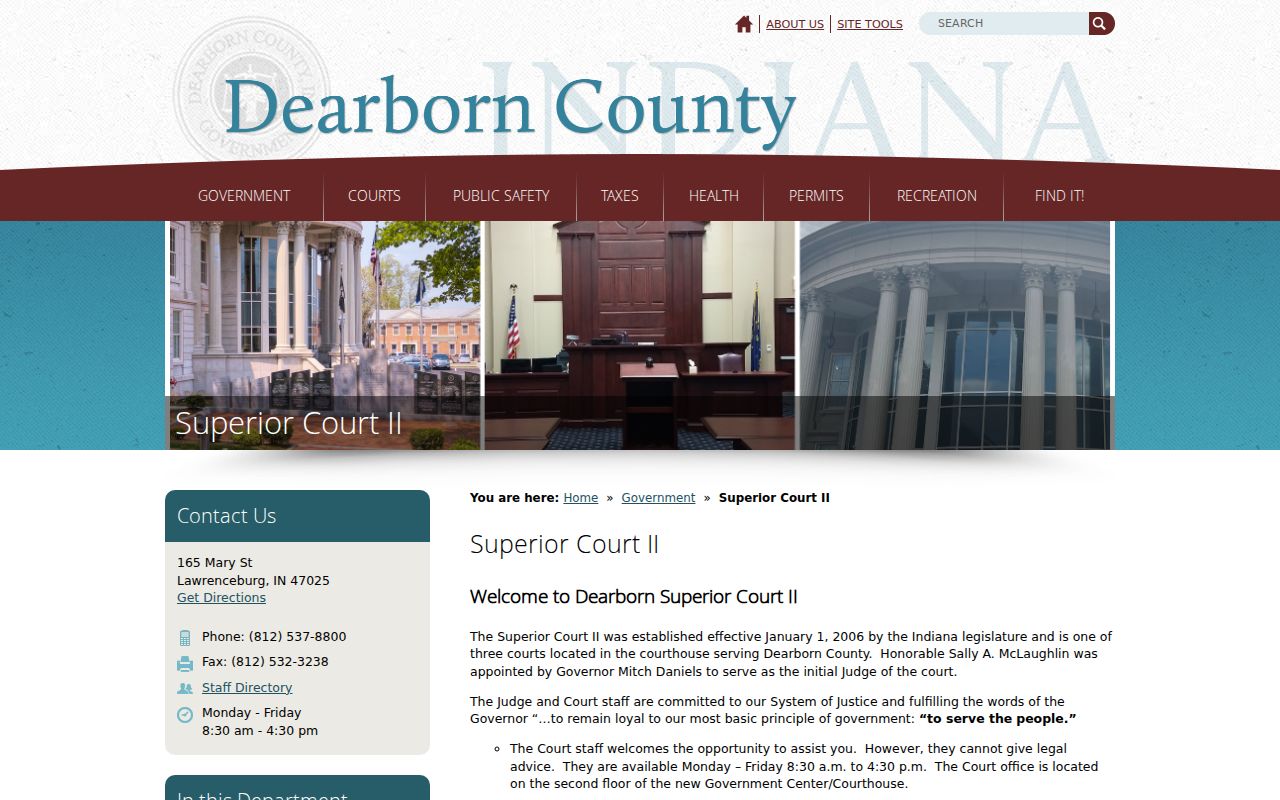
A court page names the office and how to reach it. MyCase supplies the case-level setting. Using both keeps a division name from being mistaken for a room assignment. Circuit and Superior Court I have separate pages. Lawrenceburg City Court sits as lower court 15H02.
Court Settings: What Each Field Means
A setting line is compact. Read it beside nearby CCS events. One entry may announce a hearing, record a change, or show an old date no longer controls.
| Date | The scheduled day; a later reset can replace it. |
|---|---|
| Time | The appearance or docket-call time, not a promise of when a case will be heard. |
| Courtroom | The assigned room or location; confirm it if incomplete. |
| Judge | The officer or division; a special-judge entry can change the name. |
| Setting Type | Initial hearing, pretrial, motion hearing, plea, trial, sentencing, or review. |
A setting is not a result. A plea setting proves no plea happened, and a trial setting proves no trial went forward. Later entries report what occurred. Status displays can lag, so confirm current details with the clerk.
Pink Sheets in Dearborn County Cases
Dearborn local rules use "pink sheet" as a file-notice term tied to attorney notice. It is not a countywide public calendar code. The phrase mainly helps counsel follow local procedure. The public should rely on the CCS and court confirmation for the operative date.
- CCS
- Indiana's official chronological docket of case events.
- Setting
- A scheduled hearing, conference, trial, sentencing, or review.
- Continued or reset
- A setting moved to another date; the later entry controls.
- Vacated
- A prior setting removed, calling for a search for its replacement.
The county publishes no abbreviation sheet. Never assume a short form in one file means the same thing countywide. Ask the clerk or the court to explain an unclear entry.
When a Court Date Moves
Asking does not continue a case. The court must act, and the new event must be checked. Dearborn local Trial Rule 9 covers continuances requested two weeks before trial. Other changes turn on the case and the order. A pending motion never permits missing a listed setting.
Search the full CCS around the old date. Look for an order granting or denying a motion. Look for a line vacating the setting, and a replacement date. Call the assigned court if the newest entry conflicts with a notice. Attorney notices, clerk records, and public displays are different layers, but the court decides which instruction controls.
After-Hours Dearborn County Filings
Dearborn local Trial Rule 4 sets the cutoff. Filings received after 4:30 p.m. get stamped the next business day. That matters when a late filing is expected to change an imminent setting. Submission and the formal file date are not the same event. The CCS may not reflect a schedule change right away.
Never infer a setting vanished because a motion went in late. Check whether the clerk accepted it, whether the judge entered an order, and whether a later CCS line moved the date. Indiana's E-Filing System feeds Odyssey. But MyCase is only a public information view, not the attorney filing interface and no promise of real-time display.
Dearborn County Jury Dates Use Another Channel
A jury notice and a case setting travel on separate tracks in Dearborn County. The county's jury channel, including its cancellation line, speaks to summoned jurors only. It can tell a juror whether to report tomorrow morning. It cannot wipe out a party's hearing. That court date lives in the case CCS and with the assigned court.
Match the notice to your role. Jurors follow the summons and the official jury instructions. Parties and witnesses read the case record and any court orders instead. If you hold both kinds of paper, check each one through its own official source before you act.
Missed Settings and What Comes Next
Miss a setting in Dearborn County? Act fast. Pull up the docket and look for a new order or a failure-to-appear entry. Then reach out to the court or your lawyer. What happens next turns on the case type and the judge's order, from a warrant or bond action in a criminal docket to an adverse ruling in a civil one. Reading the court docket helps you see the fallout. But it cannot undo the missed court date itself.
Missed a setting? Contact the assigned Dearborn County court or your lawyer at once and ask what order was entered.
Do not appear or assume a new date without confirming court instructions.
An Indiana attorney can advise how to address the missed setting.
Keep the full case number handy for any Dearborn County court date that sits further out. Then recheck the newest CCS entry as the appearance gets close, since that is where changes to the court docket show up first. Plan for security screening and travel time, though only the court can confirm the room and the attendance rules.